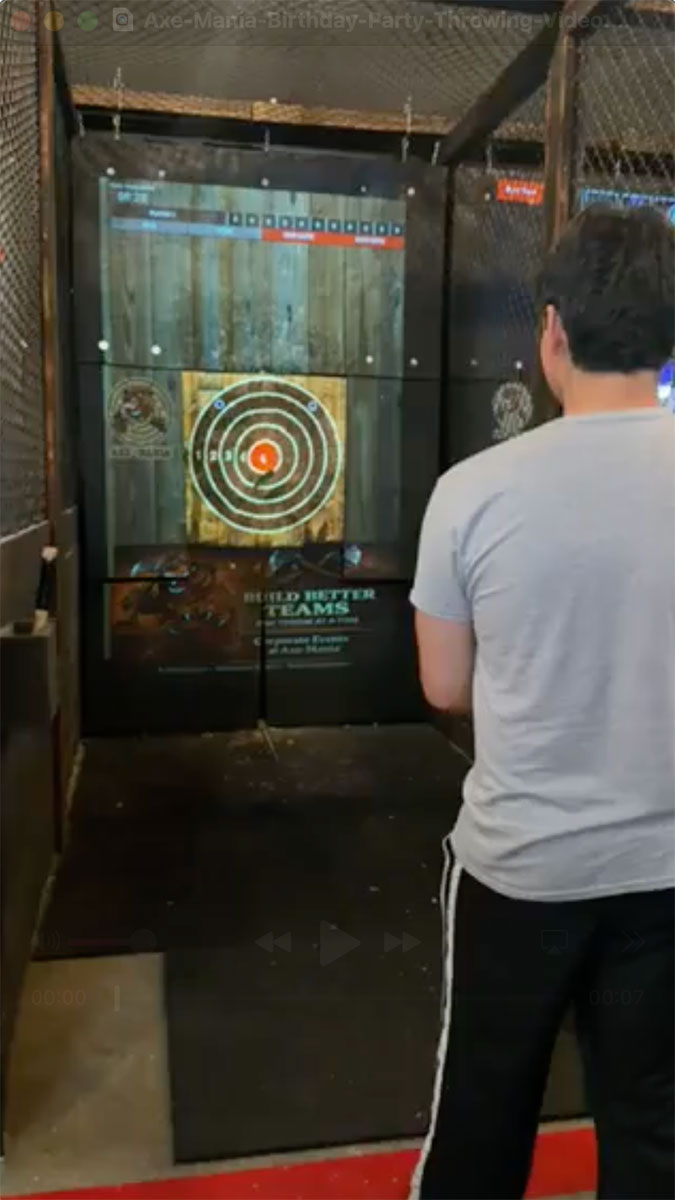
Learning how to throw an axe takes about ten minutes. Learning to throw one well takes a few more, and that is the part nobody tells you. Strength has almost nothing to do with it. Control does, rhythm does, and a clean release does most of the rest.
Our coaches have watched thousands of throws come off the line at our Kingwood venue, including a fair number of spectacular misses, so we know exactly where a first-timer loses the throw. This guide walks you through the grip, the stance, the step, the release and the rotation, then covers what to wear, how to actually practice, and the drills that turn a lucky bullseye into a repeatable one. Then come throw with us and try it for real.
How to Throw an Axe: The Five Things That Matter
Every good throw is the same five moves in the same order. Get them in the right sequence and the axe does the work for you.
1. Relax your grip. New throwers hold the handle like they are about to drive a nail. A tight grip fights the release and kills the spin. Hold it the way you would hold a dart: firm enough that it will not slip, loose enough that it can leave your hand cleanly.
2. Square up to the target. Feet about shoulder width, dominant foot slightly back, shoulders facing the wood. Your body should already be aimed where you want the axe to go before your arm moves at all.
3. Bring it straight back over your head. Two hands or one, it does not matter, but the path has to be straight. Any drift left or right at the top of the swing shows up as a miss at the target.
4. Step forward and follow through. A comfortable step as you throw feeds momentum into the axe without you having to muscle it. Let the arm finish the motion pointing at the target instead of stopping short.
5. Release early, at eye level. This is the one everyone gets wrong. Most beginners hold on too long, which drops the handle and buries the axe low. Let go around eye level and let the rotation carry it home.
All five happen inside about a second and a half, which is why coaching beats reading. Every lane at Axe-Mania has a coach walking guests through this before the first throw, and it is included with any lane you reserve.
One Spin or Two? Read the Bounce
The one-spin throw
Stand about twelve feet back and let the axe make a single full rotation before it reaches the wood. This is the throw almost everybody should learn first. The release point is forgiving, the timing is easy to feel, and it is the throw our lanes are built around.
Fix a low stick: you released late. Let go a beat earlier.
Fix a handle-first bounce: you released too early, or you stepped too far forward.
The two-spin throw
Step back several feet and the axe gets time for a second rotation. It looks impressive and it is genuinely harder, because the release window is smaller and your distance has to be consistent every time.
Try it once you are sticking eight of ten from the one-spin line. Before that it just teaches your arm bad habits you will have to unlearn later.
Bounces are normal and they are not dangerous here. Every lane has anti-bounce borders, and the safety rules that keep the room relaxed are all laid out in our guide to axe throwing rules, safety and age limits.
What to Wear Axe Throwing
There is exactly one hard rule: closed-toe shoes. No sandals, no flip-flops, no exceptions, and it is the single thing most likely to catch a group out on arrival.
Beyond that, dress the way you would for bowling. Something you can raise both arms in freely. Jeans and sneakers are the uniform around here. Skip anything tight across the shoulders, leave the long dangly jewelry at home, and tie long hair back so nothing crosses your eyeline at the release. If you are coming straight from work, that is fine too, we just suggest losing the blazer before your first throw.
Everything else is on us. Axes, coaching, lanes and scoring are all part of a booking, so there is no gear to buy and nothing to bring except closed-toe shoes and a group worth beating.
Axe Throwing Training: Four Drills That Actually Work
Repetition alone does not make you better, it just makes your current throw more consistent. These four drills fix specific faults, and each one takes about ten minutes of lane time.
THE TEN-THROW BASELINE
Throw ten times with no adjustments and count how many stick. That number is your starting point. Do not change anything until you have it, because you cannot tell what a fix did if you never measured what came before it.
THE ONE-VARIABLE RULE
Change one thing per set of ten. Grip pressure, or step length, or release height, never two at once. Almost everyone who plateaus is changing three things a throw and learning nothing from any of them.
THE HALF-STEP LADDER
Sticking low? Move a half step back and throw five. Still low? Another half step. Distance corrects rotation faster than trying to consciously re-time your release does.
THE SILENT SET
Throw five without looking at the score. Watch the axe leave your hand instead. Most throwers have never actually seen their own release, and it is where the fault usually lives.
Digital scoring makes all of this easier, because the lane keeps the record for you and you can see a set of ten at a glance. Switch between the game modes once the basics feel solid: different targets reward different kinds of aim, and it is a faster way to improve than throwing at the same bullseye all night.
Where to Practice Around Kingwood
Nine projected lanes, digital scoring, anti-bounce borders and a coach on the floor, ten minutes up Highway 59 from Humble and a short drive from Atascocita, Spring, New Caney, Porter and Splendora. Ages eight and up can throw, so this works as a family afternoon as easily as a night out.
Walk in when the mood strikes or check lane options and reserve ahead, which we would recommend on a Friday or Saturday. Bringing a crowd? Groups have their own path through planning an event, and a competitive group with a leaderboard running is comfortably the best version of a birthday party we host. Coming from the south side, our Humble page has directions and there is more to fill an afternoon in our roundup of things to do in Humble.
Questions First-Timers Ask
How long does it take to learn how to throw an axe?
Most people stick their first axe inside five or six attempts once a coach has walked them through the grip and the release. Getting consistent takes a session or two. Nobody arrives good at this, which is a large part of why it is fun.
Do I need to be strong to throw an axe?
No. Technique beats strength every single time, and plenty of the best scores on our leaderboard belong to people who muscle nothing. Throwing hard is usually what causes a bounce.
What should I wear axe throwing?
Closed-toe shoes are required, no exceptions. Otherwise wear something you can move your arms in freely. Jeans and sneakers are perfect. Tie long hair back and skip loose jewelry.
Why does my axe keep bouncing off the target?
Almost always rotation. If it hits handle first you released too early, and if it slaps flat or drops low you held on too long. Adjust your distance by a half step before you change anything about your arm.
Is coaching included?
Yes. A coach walks every group through grip, stance and release before the first throw, and stays on the floor for the session. You never have to work it out alone.
What age can start throwing?
Ages eight and up can throw at Axe-Mania. Everyone signs a waiver first, and you can find the full rules in our safety and age limits guide or on the FAQ page.
Come Find Out Who In Your Group Can Actually Throw
Nine lanes, a live scoreboard and a coach who will fix your release in about thirty seconds. Reserve a lane in Kingwood and settle it properly.

- Best Birthday Party Places in Kingwood for Kids, Teens and Adults - October 12, 2026
- 10 Team Building Ideas in North Houston Your Crew Will Actually Enjoy - October 9, 2026
- Axe Throwing vs. Rage Room: Which Houston Stress Reliever Is Right for You? - October 8, 2026